
Aerospace Quality Recovery: From fragmented backlogs to controlled execution
A multi-site FAIR recovery case study
Client Profile
A global aerospace manufacturer executing a five-year corrective-action plan to eliminate FAIR backlogs across multiple manufacturing locations and supplier workstreams.
CHALLENGE
Slipping multi-site schedules
NEED
Scalable FAIR expertise
OUTCOME
Controlled recovery model
The Challenge
One year into the recovery plan, several locations were already missing targets and extending scheduled completion dates. Although corporate FAIR policies and procedures existed, actual practices varied significantly by site.
The customer needed to address four connected challenges:
- Limited internal capacity to complete the required FAIR work
- Different workflows, systems, responsibilities, and priorities across sites
- Insufficient enterprise visibility into backlog status, constraints, and performance
- Quality and delivery risk created by incomplete FAIR packages associated with the corrective action response
The Strategic Crossroads
The customer could continue managing each backlog through site-specific practices and limited internal resources, or establish a coordinated recovery model that combined specialized capacity with common governance and performance visibility.
OPTION 1
Continue decentralized recovery
Separate site plans, limited capacity, and inconsistent visibility
DECISION
Move to a managed enterprise model
Standard framework with site-specific execution
OPTION 2
Partner for scalable execution
Qualified resources, workflows, dashboards, and quality controls
The Solution
The customer selected Verify Inc. to build and operate a multi-site FAIR recovery model. Verify began with onsite assessments to understand how work was actually performed and to identify differences between corporate requirements and local practice.
Verify then established a common five-phase framework and tailored each site’s workflow to its authorized scope. Web-based workflow and dashboard tools, including AI-assisted capabilities, connected milestones, accountability, performance, issues, and customer visibility.
Key Capabilities Delivered

Onsite Assessment: Current-state evaluation of site workflows, systems, access needs, roles, and operating constraints.
Workflow Design: A common five-phase FAIR framework configured to the phases and steps authorized for each location.
Resource Qualification: Standardized training, demonstrated execution, and customer evaluation before independent production.
Digital Performance Management: Milestone tracking, dashboards, issue management, and real-time visibility for operators and customer stakeholders.
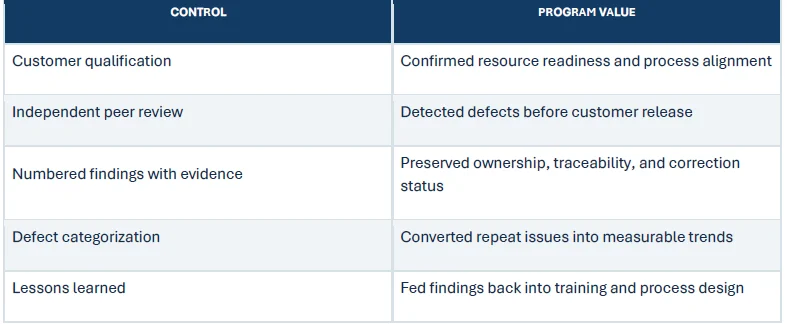
Quality Control: Independent peer review, defect categorization, correction tracking, lessons learned, and ongoing process refinement.
Implementation Approach
Verify operated as an integrated extension of the customer’s team, combining centralized program governance with site-level execution. The model created consistency without ignoring legitimate differences in scope, systems, and local operating requirements.

Operating Model
- Daily engagement with remote production resources and weekly team operating reviews
- In-person onboarding for onsite resources to establish access, process, and customer alignment
- Smartsheet workflows that assign work, enforce required data entry, and track progress by milestone
- Site dashboards that make individual and team performance visible
- Issue tracking used to categorize questions, dependencies, rework, and required decisions
- Lessons learned incorporated into training and subsequent workflow updates
Layered Quality Controls
The quality system matured as the operating process stabilized. Customer qualification verified initial resource readiness, while independent peer review created an internal control before release.
Results and Outcomes
Within six months, the program expanded from an initial priority workstream to five locations or supplier workstreams and established measurable improvements in productivity, quality, and management visibility.
1,964
workflow-stage deliverables
52%
cycle-time improvement
94% to 99%
internal FPY improvement
- Average combined ballooning and FAI Shell creation cycle time reduced from 3.60 to 1.73 hours within the initial workstream
- Earlier identification of bottlenecks, access constraints, customer dependencies, and defects before release
- Improved separation of active work, rework, customer-dependent items, and completed workflow deliverables
- Real-time visibility into performance against production targets and milestones
Value Delivered
Within six months, the program expanded from an initial priority workstream to five locations or supplier workstreams and established measurable improvements in productivity, quality, and management visibility.
ENTERPRISE VISIBILITY
See backlog status, productivity, quality, capacity, and constraints
EARLIER INTERVENTION
Identify issues before they become broader schedule or quality failures
SCALABLE CAPACITY
Combine remote and onsite resources within a consistent operating model
REPEATABLE CONTROL
Reuse the framework for additional sites, phases, and quality-recovery programs
Lessons and Next Steps
The engagement demonstrated that enterprise standardization cannot be achieved by applying one documented procedure uniformly to every location. Successful recovery begins with understanding actual site conditions and then building a common framework that accommodates necessary operational differences.
The next priorities are to strengthen end-to-end outcome reporting, distinguish workflow output from customer-accepted FAIRs, continue monitoring internal and external first-pass yield, and extend the operating model to additional authorized sites and services.