
Multi-Site Steel Distribution: From site-level practices to consistent network controls
A multi-site steel distribution improvement case study

Client Profile
A large multi-site structural steel distributor and service-center organization operating regional facilities with warehouse, material-handling, and value-added processing capabilities.
CONSTRAINT
Site-to-site variation in local controls
NEED
Consistent operating discipline
OUTCOME
Stronger multi-site capability
The Challenge
The two assessed facilities were established, capable operations supported by mature enterprise systems. Both had sufficient footprint, processing equipment, and warehouse capacity for the forecast demand. The improvement opportunity was not a lack of assets; it was the need to make strong corporate systems equally visible and consistently executed at the local level across multiple sites.
- At both facilities, the practical production constraints centered on warehouse staffing and overhead-crane availability rather than processing equipment.
- Visual management of operating metrics and quality information was limited in warehouse and processing areas, reducing day-to-day visibility of performance to goals.
- Workplace organization, housekeeping, staging, pedestrian controls, and material-handling discipline required stronger standardization.
- The sites faced different local workforce and logistics conditions, requiring mitigation that respected local operating realities rather than imposing a single generic response.
- Several compliance and assurance controls – including internal auditing, visitor safety communication, quality alerts, and federal-contract flow-down practices – required targeted reinforcement at one or both locations.
The Strategic Crossroads
The company could rely on strong corporate systems and allow each location to continue closing gaps through local practices, or use a common assessment-and-mitigation method to identify site-specific weaknesses while strengthening a repeatable operating model across the network.
OPTION 1
Continue site-by-site improvement
Strong corporate systems, but uneven local visibility and execution
OPTION 2
Deploy a common multi-site improvement model
Independent assessment, local mitigation, enterprise consistency
SELECTED PATH
The Solution
Verify assessed the two regional operations independently, then applied a common risk-mitigation framework that preserved effective enterprise practices while closing local gaps. The result was a coordinated improvement program with common objectives and site-specific actions.
Key Capabilities Delivered
1
ASSESS
Validate actual site conditions
2
ANALYZE
Separate asset capacity from operating constraints
3
MITIGATE
Implement targeted local controls
4
SUSTAIN
Embed visibility and repeatability
Capacity & Constraint Analysis Confirmed adequate processing and warehouse capacity while identifying labor and crane availability as the shared operating constraints.
Visual Performance Management: Expanded site KPI displays using real-time information from the metal-service-center ERP and made quality issues more visible to the workforce.
Workplace & Safety Controls: Strengthened housekeeping, staging, pedestrian protection, tool organization, signage, visitor safety communication, and related shop-floor controls.
Quality & Compliance Reinforcement: Closed local gaps in internal auditing, quality-alert communication, information-system access, and defense-contract compliance routing.
Workforce Support: Applied site-specific recruiting and retention actions, including referral incentives and broader community recruiting outreach.
Implementation Approach
The engagement used one common improvement architecture across both facilities without assuming identical actions. Existing enterprise systems – ERP, approved-vendor controls, preventive maintenance, capital planning, and electronic material traceability – were treated as strengths to preserve. Mitigation focused on where local execution needed greater visibility, formality, or consistency.
Site-Specific Mitigation
SITE A
- Established a formal internal audit of the site quality manual and procedures; findings and areas of concern
were corrected and closed. - Expanded community recruiting, including outreach supporting veterans and under-represented populations.
- Added customer quality and safety concerns to work orders and strengthened quality-alert visibility.
- Clarified control of measurement devices that did not require calibration.
- Routed defense work requiring federal-clause compliance through the sister division with the established compliance process.
SITE B
- Implemented an employee referral program to support recruiting in a competitive labor market.
- Expanded visitor and contractor safety communication, including posted PPE requirements.
- Improved physical protection of information-system equipment per NIST 800-171
- Added safety lighting, pedestrian controls, guard rails, access gates, and staging controls.
- Expanded KPI and nonconformance visibility using site displays tied to ERP data.
Results and Outcomes
The combined engagement produced measurable risk reduction without requiring major new processing capacity. Both facilities finished with GREEN capacity assessments at 100%, while capability assessments reached GREEN at 84% and 86%. The work concentrated on operational discipline, workforce support, quality assurance, safety, and management visibility around already-capable physical assets.
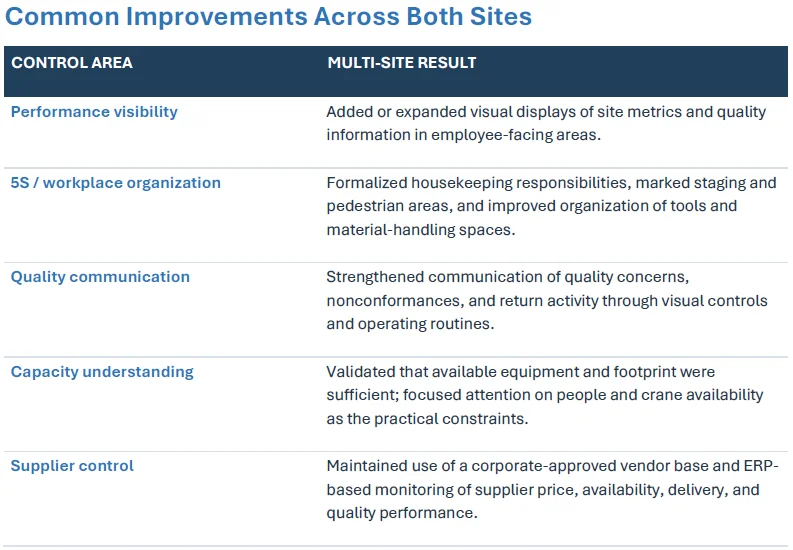
- Both sites confirmed adequate footprint, processing equipment, and warehouse capacity for forecast demand.
- Operational bottlenecks were reframed from “equipment capacity” to the more actionable constraints of warehouse labor and material movement by cranes.
- Visual management was expanded so operating KPIs and quality issues were more visible to employees and managers.
- Housekeeping, staging, pedestrian safety, and workspace organization improved at both locations.
- One site established and executed an internal audit program; the other strengthened recruiting, visitor safety, information-system protection, and shop-floor safety controls.
- A local federal-contract compliance gap was addressed through a network-level control: applicable defense work was routed through the sister facility with the established compliance process.
Value Delivered
NETWORK CONSISTENCY
A common assessment method revealed where local execution differed despite shared corporate systems.
TARGETED INVESTMENT
The analysis confirmed that major new processing assets were not the immediate need; improvement focused on operating constraints and controls.
LOCAL FIT
Mitigation was tailored to each site’s workforce, safety, quality, and compliance conditions.
ENTERPRISE LEARNING
A control proven or required at one site could inform how risk was managed across the broader network.
Client Perspective
Leaders at both locations described the engagement positively. They emphasized the value of an experienced outside perspective, noting that the assessments surfaced practical ideas and helped improve operational areas such as safety, visual management, quality communication, and day-to-day execution.